
Table of Contents
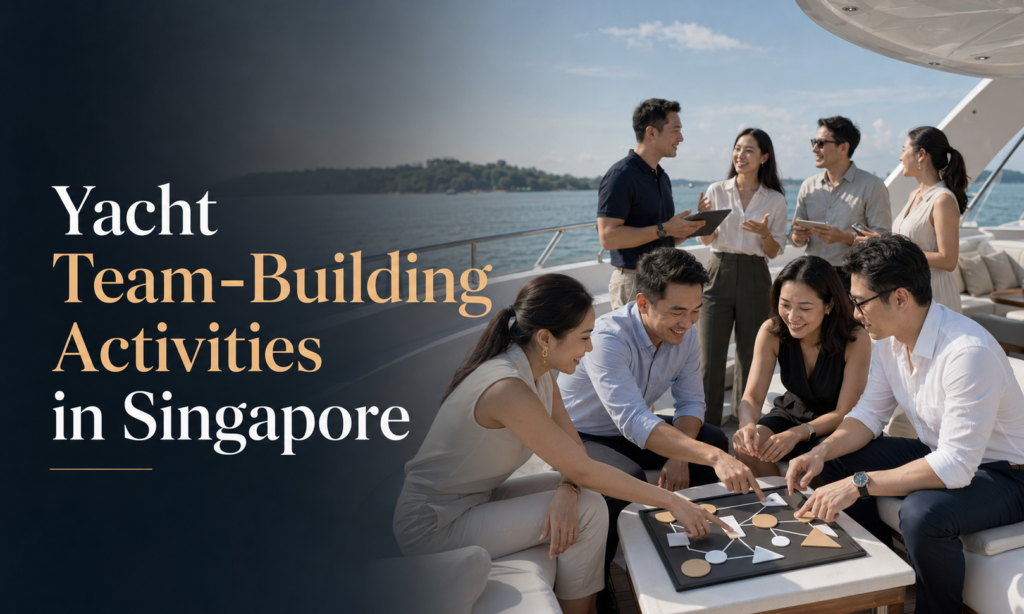
The best yacht team building activities in Singapore are not necessarily the most energetic ones.
The right mix depends on the team objective, group size, yacht layout, activity level, weather conditions and how much unstructured conversation the group needs.
A yacht creates a shared journey, but the venue alone does not build a team. The organiser still needs to design activities that help people communicate, collaborate and spend useful time together.
Start with the team objective
Choose one primary outcome before selecting games or water activities. Common outcomes include:
- Helping new colleagues become comfortable with one another
- Improving communication across departments
- Giving an established team time to reconnect
- Encouraging problem-solving outside normal work roles
- Celebrating progress after a demanding period
The objective determines the programme. A newly formed team may benefit from light icebreakers and small-group tasks. A leadership team may need facilitated discussion and reflection. A group celebrating a milestone may need less structure and more time for shared food, conversation and recreation.
EagleWings presents its yachts for team offsites and company retreats on its corporate yacht charter page. Use the outcome to explain what the group must be able to do onboard.
Choose from four activity types
A balanced programme normally combines several activity types instead of filling the charter with one long competition.
1. Light icebreakers
Icebreakers should help people begin talking without creating embarrassment. Suitable formats include paired introductions, short team prompts, observation challenges or a simple “find someone who” exercise adapted to the group.
Keep the instructions short. The yacht, view and departure already give people something to discuss, so the activity only needs to start the conversation.
2. Collaborative deck challenges
Deck-based challenges can focus on collaboration and communication without requiring complex equipment. Examples include:
- A timed team-planning challenge
- A photo-story assignment based on the voyage
- A small-group puzzle with different information given to each member
- A route or event scenario that requires joint decisions
- A creative challenge in which teams present an idea at the end
Design each task around the available deck space. Activities should not block walkways, food service or safety areas.
3. Optional water activities
Water activities can add energy, but they should be optional and suitable for the group. The EagleWings I page lists a kayak and motorised craft with towable toys, while the EagleWings V page lists motorised craft with towable toys and other add-on services. Availability, operating conditions and supervision should be confirmed for the selected yacht.
Before including any activity, ask:
- Can all interested participants take part safely?
- What clothing or personal items are required?
- How much programme time will preparation and recovery use?
- What will non-participants do?
- What is the alternative if weather conditions change?
An optional activity works best when guests who stay onboard still have a meaningful experience.
4. Reflection and team conversation
Reflection connects the experience back to work. It does not need to feel like a formal workshop. A facilitator can ask each small group to discuss:
- What helped the team make decisions?
- When did communication become unclear?
- Who created space for others to contribute?
- What should the team carry back into its daily work?
Keep this section proportionate. Ten focused minutes can be more useful than a long speech at the end of an active programme.
Match the programme to the yacht and group size
Group size affects facilitation, movement and the number of simultaneous activities. A large group may need smaller teams and several activity stations. A small group can take part together.
Yacht type also shapes the experience. A catamaran generally provides a wider platform and can support more social movement. A monohull may create a closer and more intimate group setting. The better choice depends on the programme rather than the label.
For larger groups, review the layout and facilities of EagleWings I or EagleWings V. For a smaller retreat, compare the group’s needs against a yacht such as EagleWings II. Listed capacity does not replace a discussion about usable activity space.
Build a programme with energy changes
A team-building itinerary should move between higher and lower energy instead of demanding constant participation.
One possible structure is:
- Arrival and informal welcome
- Safety briefing
- Light icebreaker after departure
- Collaborative small-group challenge
- Catering break and unstructured conversation
- Optional water activity or relaxed cruise
- Short reflection
- Team photo and return
Charter duration affects how much can fit comfortably. Allow time for boarding, transitions, food and changes in activity. If the programme is too full, participants may spend more time listening to instructions than connecting with one another.
Design for inclusion, weather and safety
Inclusive team building gives people more than one way to participate. Consider confidence in water, mobility, age range, dietary requirements and the social comfort of the team. Do not make one physical activity the only route to recognition.
The safety briefing and crew instructions take priority over the activity schedule. Review the current yacht charter FAQ for boarding, weather, safety, routes and onboard conditions. Confirm the final programme with the charter team and prepare a weather alternative that can work on deck or inside.
Use catering as part of the team experience
A catering break is not dead time. It gives colleagues space to talk outside assigned groups and lets the programme breathe.
Plan when food will be served, where guests will eat and whether an activity must stop during service. The yacht catering options can be reviewed alongside the group size, dietary needs and itinerary.
Avoid placing the main meal immediately before a high-movement activity. The sequence should feel comfortable for participants and workable for the crew.
Decide whether the event needs a facilitator
A facilitator is useful when the event has a learning objective, several teams or a structured reflection. The facilitator should know the yacht layout, timing and safety boundaries before the event.
For a social offsite, the organiser may only need clear instructions and one person to keep time. For a cross-department programme or leadership retreat, an experienced facilitator can help connect the activity to workplace behaviour without turning the charter into another office meeting.
Complete the activity brief
Before confirming the event, record:
- Team objective
- Final group size
- Selected yacht and usable deck space
- Activity sequence and timing
- Facilitator or activity owner
- Required equipment
- Water-activity participation
- Safety and weather alternative
- Catering break
- Reflection question
Once the activity brief is ready, use the yacht charter enquiry form to discuss the group, preferred date, yacht and proposed programme.